
The Rise of Family Buying
Something has been changing in the way families in Metro Vancouver approach buying a home. It’s not dramatic or sudden — it’s been building quietly for years. But if you pay attention to what people are actually doing, rather than what the traditional home buying playbook says they should do, the shift is hard to miss.
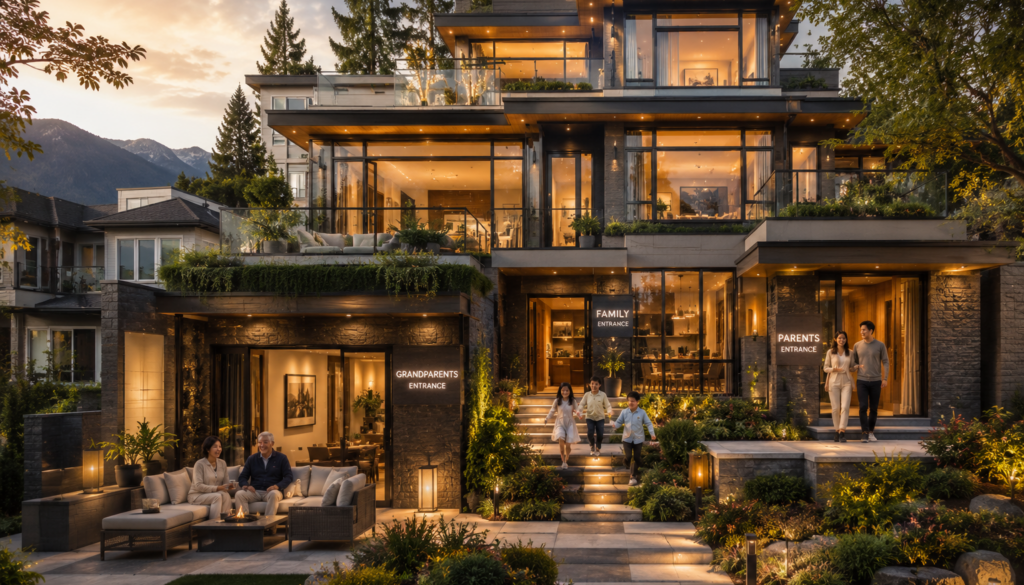
More and more families are buying together. Not just living together under one roof the way people have always done — but deliberately buying properties that are designed to house more than one generation, with separate living spaces, separate entrances, and enough independence that everyone can actually make it work long term.
It’s called multigenerational living. And in Vancouver, it’s becoming less of a workaround and more of a genuine strategy.
The Numbers Behind the Trend
This isn’t just something you hear about anecdotally. Statistics Canada counted 441,750 multigenerational households across the country in the 2021 census — up more than 21% since 2011, making it one of the fastest-growing household types in Canada. When you include broader intergenerational arrangements where parents live with adult children, that figure covers close to 9.5 million Canadians.
BC sits near the top of the country for multigenerational living, second only to Ontario, with Metro Vancouver’s rate running noticeably higher than the national average. In Surrey alone, nearly one in ten households is multigenerational. That’s not a niche trend — that’s a necessary and logical shift in how families here are choosing to live.
And it makes sense when you look at the reasons behind it.
Why It’s Happening Here
Vancouver has always had a higher-than-average rate of multigenerational living, partly because of the city’s cultural makeup. Large South Asian, Chinese, Filipino, and Korean communities have long embraced the idea of multiple generations living close together — not as a financial compromise, but as a cultural norm and a natural way to structure family life.
But the trend has moved well beyond any one community. The reality of Vancouver’s housing market has brought a much wider range of families to the same conclusion. When the average home price in Metro Vancouver sits around $1.1 million, buying independently is simply out of reach for a growing number of people. Pooling resources across generations — a parent’s equity combined with an adult child’s income — makes ownership possible in a way that going it alone often doesn’t.
At the same time, the population is aging. More families are thinking about what it looks like to have aging parents nearby — close enough to support, but with enough independence that everyone maintains their own space and their own sense of home. A multigenerational property, done right, solves both problems at once.
What BC’s New Zoning Rules Changed
For a long time, the biggest barrier to multigenerational housing wasn’t the desire — it was the zoning. A family might want to build a separate suite for grandparents or create two distinct living spaces on one lot, but the rules in most municipalities made it complicated, expensive, or outright impossible without going through a lengthy rezoning process.
That changed significantly with BC’s Bill 44, passed in late 2023 and in effect across municipalities by 2024. The legislation now requires every BC municipality to allow between three and six units on lots that were previously zoned for single-family homes — no rezoning required. That means a family can now build a proper multiplex on a standard lot, with separate units, separate entrances, and separate kitchens, legally and without the red tape that used to make it so difficult.
Vancouver and Burnaby are the furthest ahead in implementing this, with established permit processes and active construction already underway. The result is that multigenerational living has gone from something families pieced together as best they could to something the system is now actively set up to support.
What It Actually Looks Like in Practice
The most common setup families are working with right now is a main house with a basement suite and a laneway home. That gives three separate living spaces on one lot — one for each generation, or one for family and one as a rental to help cover the mortgage.
It can be a challenging setup depending on the city’s requirements and legality — understanding ownership can be overwhelming. Co-ownership arrangements between family members need to be thought through carefully — who is on title, how costs are shared, what happens if one party wants to sell or needs to refinance. These are conversations worth having with a lawyer or notary before anything is signed, not after.
There’s also the practical reality of what it’s like to actually live that way. Proximity works best when everyone has genuine independence — their own entrance, their own kitchen, their own space to close the door on at the end of the day. The families who make it work tend to be the ones who designed the arrangement with that independence built in from the start, rather than trying to retrofit privacy into a space that wasn’t designed for it.
Is It the Right Move for Your Family?
Multigenerational living isn’t for everyone. It requires a level of planning, honest conversation, and legal clarity that not every family is ready for. But for the families it works for, it can be genuinely transformative — a way to get into the Vancouver market that wouldn’t otherwise be possible, a way to keep aging parents close without anyone giving up their independence, and a way to build shared equity that benefits more than one generation over time.
If it’s something your family has been thinking about, the starting point is a real conversation — about what each person actually needs from the arrangement, what the financial structure looks like, and whether the property you’re looking at can actually deliver the independence that makes multigenerational living sustainable.
The trend is real, the zoning now supports it, and for a growing number of Vancouver families, it’s becoming the smartest path forward.
Sources & Further Reading
VanPlex. Toronto Talks Multi-Gen Housing. Vancouver Builds It. April 2026.
VanPlex. 1 in 5 Canadians Live Multigenerational: The Data. March 2026.
VanPlex. Multigenerational Living in BC: The Complete Multiplex Guide.
MultiGeneration.ca. Multigenerational Homes in Vancouver and BC. January 2026.
Rain City Properties. Multigenerational Housing Vancouver: Multiplex Guide 2026.